This is commission from my sister in law Felicity Whitton. The wood is Magnolia and It is named after French botanist Pierre Magnol. It has a lovely grain to the wood, but I found it not as easy to get the letters crisp. But once finished and polished it worked out OK. On reflection I decided to paint the letters gold, though in this picture it is not as clear as I would of liked.
I LIKE THIS PICTURE, THE CLAMP HAS MADE A SHADOW OF A CROSS.
I had an idea for a children's bench, which could have a child's name carved into it. This bench is made from solid oak, which is lovely to carve. Oak is very expensive, but I managed to get a cheaper off cut to make this sample.
Not so much Norwegian Wood but rather Iroko wood. Iroko is a large hardwood tree from west coast of Africa. It is one of the woods sometimes referred to as African Teak. I have used this wood for my carved bricks.
This is a piece that I have been working on over the last few weeks. I love the cover of the album With the Beatles, and this is my version of it. The photograph on the cover of the album was taken by Robert Freeman. He was the Beatles' most favoured photographer during the years 1963 to 1966 and shot arguably the most iconic images of them. The cover was shot by Freeman on 22 August 1963 in the Palace Court Hotel, in Bournemonth. Freeman recalls:“ They had to fit in the square format of the cover, so rather than have them all in a line, I put Ringo in the bottom right corner, since he was the last to join the group. He was also the shortest".
THIS PICTURE WAS TAKEN, JUST AFTER I HAD FINISHED THE BASIC CUT
I LIKE THIS PICTURE OF LENNON, WITH A SPOT LIGHT SHINING ON THE IMAGE
At long last, thanks to my friend Jack McInroy, my carving has had ecclesiastical approval. The Bishop of Southwark visited St Peter's School and was presented with a gift of one of my wooden bricks. According to Jack, he clearly liked it, and thought it was really wonderful. Bishop Christopher, posed outside, next to my carved flag.
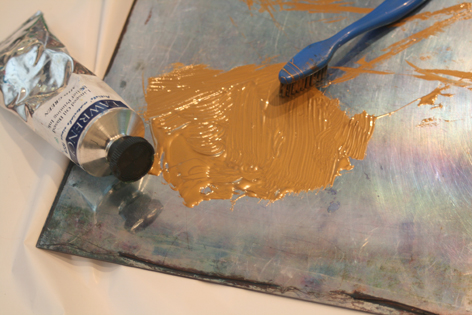
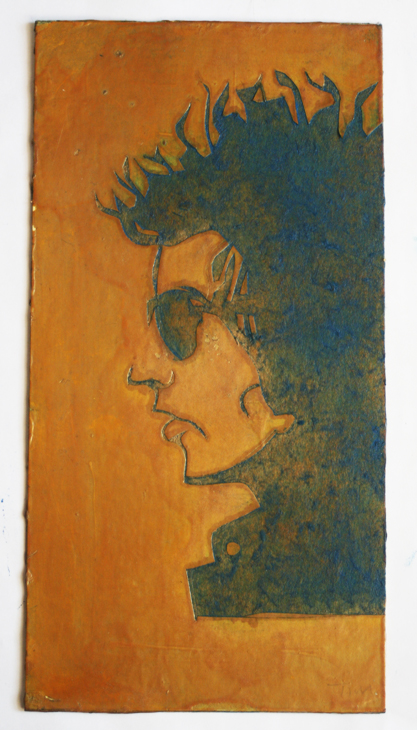
Over the last few weeks I have been experimenting with collagraphy. Which I can best describe as a mix between collage and printmaking. The results are very effective and is a reasonably cheap way to print. The problem for most is having access to a roller press. I will not go into the whole process, so here are just a few images to look at. For a full description of the process visit this site. http://www.gaylerobinson.com/webpages/whatis.html
Oil based ink and a tooth brush, to work the ink into the image
This is the cardboard plate I made, with the Dylan image hand cut out of it. It is then sealed with a waterproof seal. When dry after, about 3 hours, the ink is rubbed into the image.
This is the first print from the plate, with full ink. A little dark, me thinks.
This is the second print, which is better.
This is the third print, which is maybe a little to light. But I am still happy with the result.
This is my second instalment, looking into the Dragons of the City of London. Whilst I was researching my Boundary of Dragons, for my PGCert course last year. I found that the city’s dragons were very prominent in the area of Holborn Viaduct and Smithfield. I returned there this week to photograph them and give you just a few facts about the area. For sometime now the Viaduct has been under going major repair work so you can't photography it. I was able to find these two pictures taken by Jacqueline Banerjee of The Victorian Web. You can see what a beautiful bridge it is from these.
THESE SILVER DRAGONS ARE FOUND UNDER THE VIADUCT. THEY ARE VERY DIRTY AND IN NEED OF A GOOD CLEAN. THE BRIDGE HAS AT LEAST 40 DRAGONS ON IT.
Holborn Viaduct is a bridge in London and the name of the street which crosses it, passing over Farringdon Street and the now subterranean River Fleet. It was built between 1863 and 1869, at a cost of over two million pounds. It spanned the steep-sided Holborn Hill and the River Fleet valley. City Surveyor William Haywood was the architect and it was opened by Queen Victoria at the same time as Blackfriars Bridge. Nearby was the Holborn Viaduct station, now replaced by the City Thameslink station.
ALSO UNDER THE VIADUCT IS A WINE MERCHANT, WITH THIS DRINKING DRAGON.
WHEN PUTTING THIS BLOG TOGETHER, I NOTICED THIS DRAGON HAS LOST HIS TONGUE
MORE DRAGONS FOUND EITHER SIDE OF THE BRIDGE.
Smithfield
Smithfield – or London Central Markets – is not just the largest EU approved wholesale meat market in the country, but the oldest too.
Originally known as Smoothfield, it was a large open space just outside the city boundaries on the edge of St Bartholomew’s Priory. (The name meant a smooth plain – but the word eventually became known as smith, a corruption of the Saxon word smeth, which meant smooth).
In the Twelfth Century it was used as a vast recreational area where jousts and tournaments took place. By the late Middle Ages the area had become the most famous livestock market in the country.
There was also a murkier side to the area, because from the early Thirteenth Century it was used as a place of execution for criminals. Wat Tyler, the leader of the Peasants’ Revolt, was executed here, as was Scottish hero William Wallace and of course, it was the location of Bartholomew Fair – three days of merrymaking, dancing, selling and music which over the centuries became the most debauched and drunken holiday in the calendar. Even so, it lasted almost 700 years before it was eventually closed in 1855.
DRAGON ON MAIN ENTRANCE AND CENTRAL ARCADE
OUT OF ALL THE DRAGONS IN THE AREA, THIS IS MY FAVOURITE
DRAGONS ON SMITHFIELD WAR MEMORIAL
JUST A SPEAR THROW FROM SMITHFIELD, THE MEMORIAL OF BRAVE HEART HIMSELF.