Letter Carving, Carpentry, Art, Graphic Design, History and other interesting stuff
Friday, 19 October 2012
THE ROOT OF THE MATTER
Thursday, 27 September 2012
BOTHY AND THE SEVEN HEADED DRAGON
In
the last week or two I have become a volunteer at the Garden Museum. The Museum
is located on Lambeth Road on the south bank of the Thames, right next to
Lambeth Palace by Lambeth Bridge. The garden is planted on a very ancient grave
yard, and I have been told that the occasional human bone has been dug up
whilst planting.
On
the first day as I was sweeping up some leaves, I overheard someone reading
from an information sheet about the tomb of the Tradescant family. My ears
pricked up when I heard the words seven headed dragon. For those who have followed my blog, you will
know that several posts have been dedicated to the search for the dragons of
London. Here I was standing next to a seven headed dragon and a lady dragon at
that, and I had completely missed it. I have meet several lady dragons in my
life but they have only ever had one head, but that’s another story.
*The
great stone tomb of the Tradescants, is one of the most important churchyard
monuments in London. It was commissioned by Hester Tradescant, widow of the
younger John after his death in 1662. The panels carved into the sides of the
monument depict objects from the Tradescants’ collection and images of ruins.
Dr Roger Bowdler of English Heritage has described the tomb as pivotal in the
development of the English churchyard tomb. It was one of the very first
examples of a prominent monument to be built in a churchyard, as opposed to
inside.

On
the west end of the tomb, which faces away from the church you will see a skull
lacking a bottom jaw, and a seven head monster described by the 17th century
antiquary John Aubrey as “ an Hieroglyphical Dragon” (meaning symbolical or
emblematic). According to Topsell’s
History of Serpents (1658) dragons are the watchers and keepers of riches and
treasures. This may suggest the dragon here is to protect the rare species of
plants that had been collected, on the many adventurous and hazardous travels
of the plant seekers. On the tomb you can read these words:
“Know stranger as thou pass, beneath this stone
Lye John Tradescant grandsire, father, sone
The last died in his spring, the other two
Lived till they had travelled art and nature thro’
By their choice collections may appear
Of what is rare in land in sea and air
Whilst they (as Homer’s Iliad in a nut)
A world of wonders in one closet shut
These famous Antiquarians that had been
Both gardeners to the Rose and Lily Queen
Transplanted now themselves, sleep here, and when
Angels shall with their trumpets waken men
And fire shall purge the world, these hence shall rise
And change this garden for a Paradise.”
Next
to the tomb of the Tradescants, you will find resting place of another famous
family. Admiral William Bligh, of mutiny on the Bounty fame also has a tomb in the
garden. Admiral William Bligh, who became an Admiral after the mutiny lived in Lambeth. Just a short walk up Lambeth Road opposite
the Imperial War Museum you will find his blue plaque. Another interesting fact: After the mutiny Bligh was appointed governor of New South Wales, so the Garden gets a lot of Aussie visitors to see 'Governor' Blighs tomb.
The
Bothy
According
to Wikipedia, a bothy is a basic shelter, usually left unlocked and
available for anyone to use free of charge. It was also a term for basic
accommodation, usually for gardeners or other workers on an estate. Bothies are
to be found in remote, mountainous areas of Scotland, Northern England,
Ireland and Wales. The Garden shed in the Garden Museum is known by some as the
Bothy. It certainly is small and basic, but you couldn’t describe it as being
remote or in a mountainous area.
Anyway
I knocked a carving so any would be travellers looking for accommodation for
the night would know where to stay. One such local traveller turned up at the
weekend a Mr F. Fox. On the Lambeth road side of the garden are few very tall Plane
trees and when autumn comes the garden fills with Plane tree leaves, which are a
real problem. It just so happened, I had a piece of Plane timber, so I used it to
carve the sign. It seemed kind of apt and I carved a leaf on as well. Normally I would plain smooth the timber, but this time I left it rustic, I think its better.
So
why not give the Garden Museum a visit and see for yourself. At the very least
visit the Cafe inside and enjoy the lovely food on offer. This culinary heaven
has just been placed in the top ten museum restaurants in the world. Taste the
food for yourself and see why.
* Source: www.gardenmuseum.org.uk
Monday, 10 September 2012
TEMPEST - BOB DYLAN CARVING
BLOG POST No. 70
This week sees the release of Tempest, the 35th album by Bob Dylan, at 71 years of age, that is some achievement. The album is a superb
addition to any record collection. Anyway, I carved this little tribute to Mr
Dylan. The timber is Elm, a wood I have not carved before, a little hard to carve, especially with regard to the detail, but I was happy with the end result.
The last track on the album is 'Roll On, John' a moving tribute to John Lennon. Here is a Lennon carving I also completed recently. Carved into Yew.
This and and some of may other work can be seen and purchased at:
Wednesday, 29 August 2012
ABNEY PARK - THE SEARCH FOR SAMUEL BAGSTER
![]() |
| SAMUEL BAGSTER |
My wife
Judith has an aunty called Joy Bagster. Joy, like my dear wife is from the Dublin,
Ireland. On a recent trip to London. Joy and myself, made a visit to Abney Park
Cemetery, in search of the graves and final resting place of long lost
relatives. In Joy’s case these relatives turn out to be quite famous.
Abney Park
Cemetery is in Stoke Newington and is one of the Magnificent Seven London
cemeteries. A total number of 196,843 burials have taken place there as of the
year 2000. In 1832 Parliament passed a bill encouraging the establishment of
private cemeteries outside London, and later passed a bill to close all inner
London churchyards to new burials. Over the next decade seven cemeteries were
established: Kensal Green Cemetery-1832, West Norwood Cemetery-1837, Highgate Cemetery-1839, Abney Park Cemetery-1840, Nunhead Cemetery-1840, Brompton Cemetery-1840, Tower Hamlets Cemetery-1841. Many famous people have been buried there and if you like looking around over
grown grave yards, this is just the place. It comes complete with a derelict chapel
in the middle of it. A perfect back drop if you wanted to film a Hammer Horror
film.
But myself
and Joy weren’t here to film a horror film, we were in search of the Bagster clan
and in particular Samuel Bagster.
SAMUEL
BAGSTER
Samuel
Bagster was an English publisher and printer. He was born in 1772 and died in
1851, the second son of George and Mary Bagster of Lyme Regis, Dorset on the
south coast of England.
When Samuel
was seven years old he was sent away to school with the Reverend John Collett
Ryland, Baptist minister and father to his more famous son (also) John Ryland. On leaving school, Samuel became
an apprenticed to a bookseller in The Strand, after which time he took the
entrepreneurial step of opening his own bookshop at No 81 The Strand on 19th
April 1794, when he was still only twenty-one years old.
![]() |
| SAMUEL BAGSTER FAMILY GRAVE. UNDER THE DAME YOU CAN SEE THE FAMILY MOTTO IN LATIN. WHICH I BELIEVE MEANS "MANY TONGUES ONE FAITH" |
Unsurprisingly,
given this very specific Christian background, Samuel committed to never
selling any book which might be considered questionable in taste or subject –
an approach which set him apart from the general run of society. It wasn’t long
before Samuel soon turned his attention to the publication of bibles, bringing
out a Hebrew bible,
the Septuagint (Greek) version, and the English version, with
60,000 parallel references, followed by his great polyglot bible,
which in its final form showed eight languages at the opening of the volume. As
the firm grew over the years Samuels children joined the family business and it
became Bagster & Sons.
![]() |
| INSCRIPTION FOUND AT THE FOOT OF THE GRAVE |
Samuel married
Eunice Birch on the 19th December 1797. Eunice was said to be a “brave” woman
of equally high principles and a steadfast faith – a real helpmeet to her
husband throughout their long married life. They had twelve children together.
Eunice died on the day before her hundredth birthday in 1877. Only a few months earlier she had been
honoured by a personal visit from Queen Victoria, who knelt at Mrs Bagster’s
bedside to receive the blessing of her “revered and venerable servant”.
Abney Park Cemetery
Below you can see some other of the pictures I took on the day. The day was overcast most of the time, so some of the pictures are in black and white, which I think work with the subjects.
![]() |
| CROSSES AND ANGELS |
![]() |
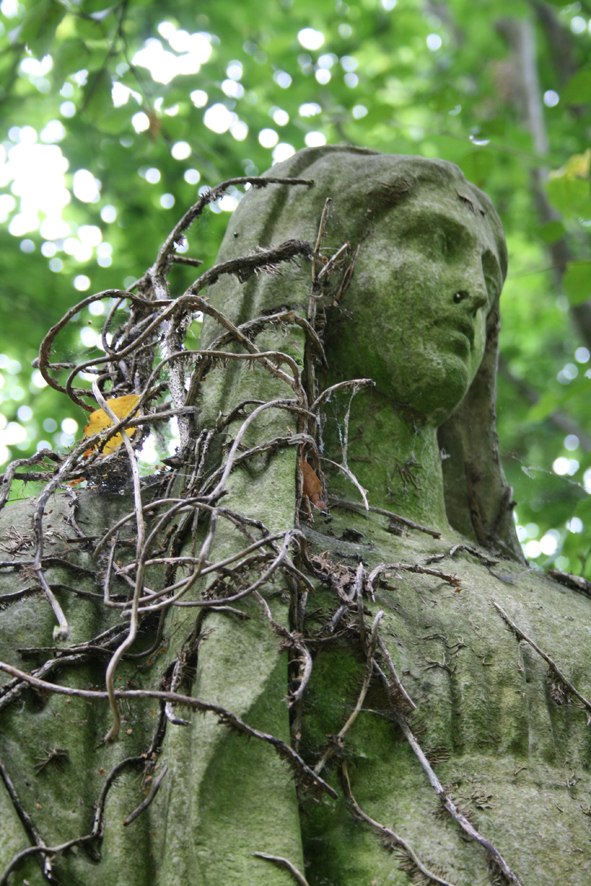
| I LOVE THE WAY TREES AND PLANTS WRAP THEMSELVES ROUND THE STATUES |
![]() |
| TWO GREAT HEADSTONES, I REALLY LIKE THE ONE WITH THE OLD CAR |
![]() |
| THESE SMALL HEADSTONES ARE PAUPERS GRAVES |
![]() |
| ISAAC WATTS |
FOR MORE INFO VISIT: www.abney-park.org.uk
Wednesday, 15 August 2012
ALPHABET TREE - LONDON PLANE
This particular piece of London Plane came from Nunhead Cemetery. It was cut down about a year or so ago and has been in the cemetery drying out. You can see when the timber was first cut how red in colour it is and what amazing patterns can be found. The timber should really be left for two or more years before carving it. But I couldn’t wait that long and had to start carving straight away. The wood was still green and moist, so it was difficult to cut the letters as sharp as I would of liked. But I was fairly happy with the rustic type finish; I hope you like it too.
![]() |
| THE WOOD REMINDS ME OF GIANT STEAK |
![]() |
| ALIEN TYPE IMAGE ON THE LEFT |
RECENT COMMISSIONS
Here are a couple of pieces I have just finished, from people I meet at the Nunhead Open Day. The first is for a garden in Sicily, Italy. The second is one of my wooden bricks, with hearts carved on top.
Tuesday, 14 August 2012
SECRET NUNHEAD - LONDON SKYLINE
This place isn’t so much secret, at least not to the
local people who live around about. But it is a strange place and without some
directing you, you may not know it is there. Brockley Footpath is a public
footpath just of Linden Grove in Nunhead. It runs down the side of Nunhead Cemetery.
![]() |
| THE SIGHT THAT FIRST GREETS YOU, AS I SAID THE X FILES COMES TO MIND |
Continue on your walk up the hill and you will see some
80 or so steps, which lead to the second and highest grass platform. Once there
admire the amazing views across London. A good time to go is in the evening as
the sun begins to set.
Monday, 13 August 2012
THE ROSE OF SHARON
This is not a subject I have covered in my blog before, and I don’t mean it to come across as a sort of sermon as I am not in a position to preach to anyone! However, I believe it to be of interest and hope you will too. When I moved into my present home, over three and half years ago now, I planted, in my garden, a small flower called the Rose of Sharon (which is a type of Hibiscus syriacus). It’s a very beautiful flower, which has a link to biblical times. It is mentioned in the Song of Solomon. Whether mine is the same as the flower mentioned by Solomon, I cannot say for sure, but for arguments sake let’s assume that it is.
KING SOLOMON
King Solomon, was the son of King David and Bathsheba. The name "Solomon" is related to the Hebrew "shalom" meaning "peace. King Solomon was known for his wisdom, his wealth and his writings. His kingdom extended from the Euphrates River, in the north, to Egypt in the south. His crowning achievement was the building of the Holy Temple in Jerusalem. Almost all the knowledge we have of him, is derived from the biblical books of Kings I and Chronicles II.
The books that Solomon wrote are found in the Old Testament; they include Proverbs, Ecclesiastes and The Song of Solomon, from which we find the Rose of Sharon. Most commentators consider the Song of Solomon to have been written in the early part of his life. It is the love story of a man and a woman. The love that Solomon had for his wife, a first love you might say. As the years went on, Solomon strayed away from his God, the God who gave him his wisdom and riches. The bible goes on to tell us that Solomon went after strange women and the gods they worshipped. They took away his heart and Solomon had a mighty fall. In total Solomon, gathered a thousand wives in his lifetime.
But like the Prodical Son, he returned to his heavenly father and went on to write the book of Ecclesiates, where he summed up his life of excess by concluding. “The words of the Preacher, the son of David, king in Jerusalem. Vanity of vanities, saith the Preacher, vanity of vanities; all is vanity”.
THE ROSE OF SHARON
The Rose of Sharon has long been known as a type of or one of the names given to Christ, along many, many others. Like The Alpha and Omega, The Bright and Morning Star, The Lily of the Valley, The Mighty God, The Everlasting Father, The Prince of Peace, The Image of the Invisible God, The Only Begotten Son of God, The Son of David, The Son of Man, The Man of Sorrows, The Sun of Righteousness, The Bridegroom, The Lamb of God, The King of Kings, The Lord of Lords, The Door, The Good Shepherd, The Chief Cornerstone, The Saviour, The Mediator, The Bread of Life, The Water of Life, The Light of the World, The Resurrection and the Life and the list goes on.
The Song of Solomon being a beautiful song that illustrates the love relationship and tender union between Christ and His Church from the beginning of time and through eternity. But how does this rose growing in a small garden in South London, next to a noisy main road and bus stop, be like Christ. Well here are just a few thoughts on the subject.
THE COLOUR OF THE ROSE
The colour of the Rose of Sharon is white with a red centre. The whiteness, Christ purity and sinlessness. The red, his precious blood that washes away sins.
His head and his hairs were white like wool, as white as snow; and his eyes were as a flame of fire; Rev 1:14
THE SPLENDOUR AND BEAUTY OF A ROSE
The splendour and beauty of Christ. A beauty that draws people to it, a beauty that is extended and placed upon his children, through Him.
Who shall change our vile body, that it may be fashioned like unto his glorious body, according to the working whereby he is able even to subdue all things unto himself. Philippians 3:21

THE SCENT AND FRAGRANCE OF THE ROSE
When you are around flowers, for a reasonable time, the scent of the flowers will permeate your clothes, revealing where you have been. We have all heard of the term ‘smelling of roses’. The more time you spend in fellowship with Christ, the Rose of Sharon, the more you will be like him, it will show in your life. You become a new person in Christ.
THE ROSE REMIND US OF SALVATION
Flowers are pretty much available to all and accessible to all people. Christ is available and accessible to all.
For whosoever shall call upon the name of the Lord shall be saved. Romans 10:13
THE HEALING POWER OF THE ROSE
Flowers provide comfort and strength. The rose itself has medicinal value. Rose oils and syrups, and rose water is made from the petals. The rose can be used to treat sore throats, ulcerated mouths, headaches, stomach problems, skin creams for chapped hands, pimples, jaundice, arthritis, infection, dizziness, liver problems and eye problems. The cooling nature of roses are used in treating burning fevers and inflammation.
So it is with Christ, in him we find healing, strength, and comfort. The death of Christ and the shedding of his blood, brought salvation and cleansing to his people.
The blood of Jesus Christ His Son cleanses us from all sin. 1 John 1:7
THE ROSE A TOKEN OF LOVE
Roses are given to those you love or care about. God’s love for mankind meant He gave us His rose, the Rose of Sharon, Jesus Christ..
For God so loved the world, that he gave his only begotten Son, that whosoever believeth in him should not perish, but have everlasting life. John 3:16
Subscribe to:
Posts (Atom)