Wednesday, 29 August 2012

ABNEY PARK - THE SEARCH FOR SAMUEL BAGSTER

SAMUEL BAGSTER

My wife Judith has an aunty called Joy Bagster. Joy, like my dear wife is from the Dublin, Ireland. On a recent trip to London. Joy and myself, made a visit to Abney Park Cemetery, in search of the graves and final resting place of long lost relatives. In Joy’s case these relatives turn out to be quite famous.

Abney Park Cemetery is in Stoke Newington and is one of the Magnificent Seven London cemeteries. A total number of 196,843 burials have taken place there as of the year 2000. In 1832 Parliament passed a bill encouraging the establishment of private cemeteries outside London, and later passed a bill to close all inner London churchyards to new burials. Over the next decade seven cemeteries were established: Kensal Green Cemetery-1832,  West Norwood Cemetery-1837, Highgate Cemetery-1839, Abney Park Cemetery-1840, Nunhead Cemetery-1840, Brompton Cemetery-1840, Tower Hamlets Cemetery-1841. Many famous people have been buried there and if you like looking around over grown grave yards, this is just the place. It comes complete with a derelict chapel in the middle of it. A perfect back drop if you wanted to film a Hammer Horror film.

But myself and Joy weren’t here to film a horror film, we were in search of the Bagster clan and in particular Samuel Bagster.  

SAMUEL BAGSTER
Samuel Bagster was an English publisher and printer. He was born in 1772 and died in 1851, the second son of George and Mary Bagster of Lyme Regis, Dorset on the south coast of England.


When Samuel was seven years old he was sent away to school with the Reverend John Collett Ryland, Baptist minister and father to his more famous son (also) John Ryland. On leaving school, Samuel became an apprenticed to a bookseller in The Strand, after which time he took the entrepreneurial step of opening his own bookshop at No 81 The Strand on 19th April 1794, when he was still only twenty-one years old.

SAMUEL BAGSTER FAMILY GRAVE. UNDER THE DAME YOU CAN SEE THE FAMILY MOTTO IN LATIN.
WHICH I BELIEVE MEANS "MANY TONGUES ONE FAITH"


Unsurprisingly, given this very specific Christian background, Samuel committed to never selling any book which might be considered questionable in taste or subject – an approach which set him apart from the general run of society. It wasn’t long before Samuel soon turned his attention to the publication of bibles, bringing out a Hebrew bible, the Septuagint (Greek) version, and the English version, with 60,000 parallel references, followed by his great polyglot bible, which in its final form showed eight languages at the opening of the volume. As the firm grew over the years Samuels children joined the family business and it became Bagster & Sons.

INSCRIPTION FOUND AT THE FOOT OF THE GRAVE


Samuel married Eunice Birch on the 19th December 1797. Eunice was said to be a “brave” woman of equally high principles and a steadfast faith – a real helpmeet to her husband throughout their long married life. They had twelve children together. Eunice died on the day before her hundredth birthday in 1877.  Only a few months earlier she had been honoured by a personal visit from Queen Victoria, who knelt at Mrs Bagster’s bedside to receive the blessing of her “revered and venerable servant”.

Abney Park Cemetery 
Below you can see some other of the pictures I took on the day. The day was overcast most of the time, so some of the pictures are in black and white, which I think work with the subjects.

CROSSES AND ANGELS
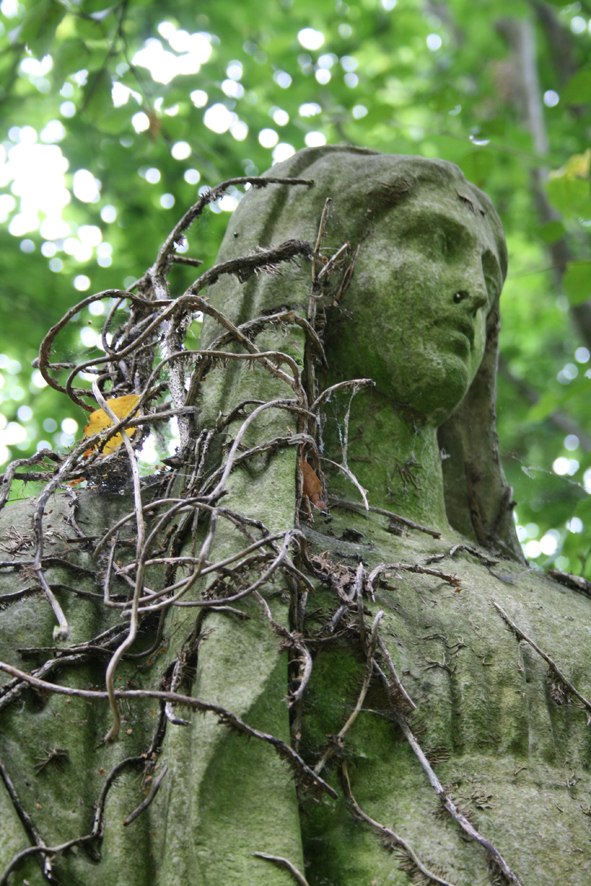
I LOVE THE WAY TREES AND PLANTS WRAP THEMSELVES ROUND THE STATUES

TWO GREAT HEADSTONES, I REALLY LIKE THE ONE WITH THE OLD CAR


THESE SMALL HEADSTONES ARE PAUPERS GRAVES

ISAAC WATTS
Isaac Watts (17 July 1674 – 25 November 1748) was an English hymn writer and theologian . A prolific and popular hymn writer, he was recognised as the "Father of English Hymnody", credited with some 650 hymns. Many of his hymns remain in use today, and have been translated into many languages.

Derelict Gothic Chapel in middle of the Cemetery 


WILLIAM BOOTH, FOUNDER OF THE SALVATION ARMY
FOR MORE INFO VISIT: www.abney-park.org.uk

Wednesday, 15 August 2012

ALPHABET TREE - LONDON PLANE


London Plane tree’s, are among the most numerous trees found on London’s streets. It was first planted here in about 1550, but most will be a little less than 300 years old. If you walk along any street and pick out the most impressive tree you see, the odds are that it will be a London plane. It is as common in Paris as it is in London; in fact it is more common. Not that the French call them London planes. The French just call them planes, or platane. Istanbul, on the other side of Europe, is also rich with planes.  

The bark can often be seen flaking off, and in doing so, sheds pollutants that may interfere with air reaching the trunk. This is one the reason why the tree has thrived in London during the periods of serious air pollution. 

THIS PICTURE SHOWS ALL THE KNOTS AND HOLES IN THE WOOD
This particular piece of London Plane came from Nunhead Cemetery. It was cut down about a year or so ago and has been in the cemetery drying out. You can see when the timber was first cut how red in colour it is and what amazing patterns can be found. The timber should really be left for two or more years before carving it. But I couldn’t wait that long and had to start carving straight away. The wood was still green and moist, so it was difficult to cut the letters as sharp as I would of liked. But I was fairly happy with the rustic type finish; I hope you like it too. 

THE WOOD REMINDS ME OF GIANT STEAK

ALIEN TYPE IMAGE ON THE LEFT 

RECENT COMMISSIONS
Here are a couple of pieces I have just finished, from people I meet at the Nunhead Open Day. The first is for a garden in Sicily, Italy. The second is one of my wooden bricks, with hearts carved on top.  


Tuesday, 14 August 2012

SECRET NUNHEAD - LONDON SKYLINE


This place isn’t so much secret, at least not to the local people who live around about. But it is a strange place and without some directing you, you may not know it is there. Brockley Footpath is a public footpath just of Linden Grove in Nunhead.  It runs down the side of Nunhead Cemetery.

THE SIGHT THAT FIRST GREETS YOU, AS I SAID THE X FILES COMES TO MIND
A short walk up the path and you will come a across a conveniently cut hole in the metal fence. There are a couple of these holes along the path. Step through the fence and you are confronted by a very steep hill. At the top, are these strange looking bunker type structures. A short climb to the top and you arrive on the top of the first of two grass covered flat surfaces. It reminds you of a place you might find in an episode of the X Files, a secret bunker or warehouse were the government conduct secret experiments and store non humans. But back to the real world, in fact they are some sort of water storage tanks.

THE 87 STEPS THAT LEAD TO THE SUMMIT


STRANGE METAL OBJECTS, THAT WOULD GRACE ANY MODERN ART GALLERY


Continue on your walk up the hill and you will see some 80 or so steps, which lead to the second and highest grass platform. Once there admire the amazing views across London. A good time to go is in the evening as the sun begins to set.

The only drawback of this place, no cleaner has been there for a very long time. So the area is covered in broken bottles, empty cans and a lot of litter. But don’t let this put you off. Just look at the amazing views you will find.


Monday, 13 August 2012

THE ROSE OF SHARON


This is not a subject I have covered in my blog before, and I don’t mean it to come across as a sort of sermon as I am not in a position to preach to anyone! However, I believe it to be of interest and hope you will too. When I moved into my present home, over three and half years ago now, I planted, in my garden, a small flower called the Rose of Sharon (which is a type of Hibiscus syriacus). It’s a very beautiful flower, which has a link to biblical times. It is mentioned in the Song of Solomon. Whether mine is the same as the flower mentioned by Solomon, I cannot say for sure, but for arguments sake let’s assume that it is.

KING SOLOMON
King Solomon, was the son of King David and Bathsheba. The name "Solomon" is related to the Hebrew "shalom" meaning "peace. King Solomon was known for his wisdom, his wealth and his writings. His kingdom extended from the Euphrates River, in the north, to Egypt in the south. His crowning achievement was the building of the Holy Temple in Jerusalem. Almost all the knowledge we have of him, is derived from the biblical books of Kings I and Chronicles II.

The books that Solomon wrote are found in the Old Testament; they include Proverbs, Ecclesiastes and The Song of Solomon, from which we find the Rose of Sharon. Most commentators consider the Song of Solomon to have been written in the early part of his life. It is the love story of a man and a woman. The love that Solomon had for his wife, a first love you might say. As the years went on, Solomon strayed away from his God, the God who gave him his wisdom and riches. The bible goes on to tell us that Solomon went after strange women and the gods they worshipped. They took away his heart and Solomon had a mighty fall. In total Solomon, gathered a thousand wives in his lifetime.

But like the Prodical Son, he returned to his heavenly father and went on to write the book of Ecclesiates, where he summed up his life of excess by concluding. “The words of the Preacher, the son of David, king in Jerusalem. Vanity of vanities, saith the Preacher, vanity of vanities; all is vanity”.

THE ROSE OF SHARON
The Rose of Sharon has long been known as a type of or one of the names given to Christ, along many, many others. Like The Alpha and Omega, The Bright and Morning Star, The Lily of the Valley, The Mighty God, The Everlasting Father, The Prince of Peace, The Image of the Invisible God, The Only Begotten Son of God, The Son of David, The Son of Man, The Man of Sorrows, The Sun of Righteousness, The Bridegroom, The Lamb of God, The King of Kings, The Lord of Lords, The Door, The Good Shepherd, The Chief Cornerstone, The Saviour, The Mediator, The Bread of Life, The Water of Life, The Light of the World, The Resurrection and the Life and the list goes on.

The Song of Solomon being a beautiful song that illustrates the love relationship and tender union between Christ and His Church from the beginning of time and through eternity. But how does this rose growing in a small garden in South London, next to a noisy main road and bus stop, be like Christ. Well here are just a few thoughts on the subject.

THE COLOUR OF THE ROSE
The colour of the Rose of Sharon is white with a red centre. The whiteness, Christ purity and sinlessness. The red, his precious blood that washes away sins.

His head and his hairs were white like wool, as white as snow; and his eyes were as a flame of fire; Rev 1:14

THE SPLENDOUR AND BEAUTY OF A ROSE
The splendour and beauty of Christ. A beauty that draws people to it, a beauty that is extended and placed upon his children, through Him.

Who shall change our vile body, that it may be fashioned like unto his glorious body, according to the working whereby he is able even to subdue all things unto himself. 
Philippians 3:21 


THE SCENT AND FRAGRANCE OF THE ROSE
When you are around flowers, for a reasonable time, the scent of the flowers will permeate your clothes, revealing where you have been. We have all heard of the term ‘smelling of roses’. The more time you spend in fellowship with Christ, the Rose of Sharon, the more you will be like him, it will show in your life. You become a new person in Christ.

THE ROSE REMIND US OF SALVATION
Flowers are pretty much available to all and accessible to all people. Christ is available and accessible to all.

For whosoever shall call upon the name of the Lord shall be saved.  
Romans 10:13 

THE HEALING POWER OF THE ROSE
Flowers provide comfort and strength. The rose itself has medicinal value. Rose oils and syrups, and rose water is made from the petals. The rose can be used to treat sore throats, ulcerated mouths, headaches, stomach problems, skin creams for chapped hands, pimples, jaundice, arthritis, infection, dizziness, liver problems and eye problems. The cooling nature of roses are used in treating burning fevers and inflammation.

So it is with Christ, in him we find healing, strength, and comfort. The death of Christ and the shedding of his blood, brought salvation and cleansing to his people.

The blood of Jesus Christ His Son cleanses us from all sin. 1 John 1:7

THE ROSE A TOKEN OF LOVE
Roses are given to those you love or care about. God’s love for mankind meant He gave us His rose, the Rose of Sharon, Jesus Christ..

For God so loved the world, that he gave his only begotten Son, that whosoever believeth in him should not perish, but have everlasting life. 
John 3:16

Sunday, 29 July 2012

LONDON DRAGONS 5 - Bank of England and more.

We are nearing our journeys end, in the hunt for London's dragons. This penultimate post finds us at The Bank of England, The Guildhall and St Mary Le Bow. All can be found a short walking distance from each other, and follow on from the dragons of Leadenhall Market.

THE BANK OF ENGLAND


The Bank of England
The dragons found sitting on the street lamps outside the Bank of England are small and black, with gold markings on there wings. They could well be the off-spring of the great Temple Bar dragon in Fleet Street, that divides the City from the West End. (see City of London - Boundary of Dragons post). These small little dragons may seem harmless enough, but any attempt to steal from the great bank will result in an all out attack, so be warned.

The Bank of England is the central bank of the United Kingdom. Sometimes known as the 'Old Lady' of Threadneedle Street, the Bank was founded in 1694, nationalised on 1 March 1946, and gained independence in 1997. Standing at the centre of the UK's financial system, the Bank is committed to promoting and maintaining monetary and financial stability as its contribution to a healthy economy.


Since its foundation, it has been the Government's banker and, since the late 18th century, it has been banker to the banking system more generally - the bankers' bank. As well as providing banking services to its customers, the Bank of England manages the UK's foreign exchange and gold reserves.

The Bank has two core purposes - monetary stability and financial stability. The Bank is perhaps most visible to the general public through its banknotes and, more recently, its interest rate decisions. The Bank has had a monopoly on the issue of banknotes in England and Wales since the early 20th century. But it is only since 1997 that the Bank has had statutory responsibility for setting the UK's official interest rate.

THE GUILDHALL
The Guidlhall
The great hall is believed to be on a site of an earlier Guildhall (one possible derivation for the word 'guildhall' is the Anglo-Saxon 'gild', meaning payment, with a "gild-hall" being where citizens would pay their taxes). During the Roman period, it was the site of an amphitheatre, the largest in Britannia, partial remains of which are on public display in the basement of the Guildhall Art Gallery and the outline of whose arena is marked with a black circle on the paving of the courtyard in front of the hall.


The first documentary reference to a London Guildhall is dated 1128 and the current hall's west crypt may be part of a late-13th century building.

The current building was begun in c. 1411, and it is the only stone building not belonging to the Church to have survived the Great Fire of London in 1666. The complex contains several other historic interiors besides the hall, including the large medieval crypts, the old library, and the print room, all of which are now used as function rooms.


The Great Hall did not completely escape damage in 1666; it was partially restored - with a flat roof - in 1670. The present grand entrance (the east wing of the south front), in what is known as Hindoostani Gothic, was added in 1788 by George Dance (and restored in 1910). A more extensive restoration than that in 1670 was completed in 1866 by City of London architect Sir Horace Joness, who added a new timber roof in close keeping with the original. This replacement was destroyed on the night of 29/30 December 1940, the result of a Luftwaffe fire-raid. It was replaced in 1954 during works designed by Sir Giles Gilbert Scott. 

St Mary-le-Bow Church, Cheapside

The highest dragon by far, is the golden weathervane dragon, found on top of St Mary-le-Bow church. My camera wasn't up to the job at getting a decent picture of this fearsome creature but you can get some idea.

SAINT MARY-LE-BOW
The first references to a church on the site of St Mary-le-Bow seem to date from 1087 by which time a Norman church had been erected there

In 1091 the roof of the church was blown off in a huge storm which battered the south of England during the winter of that year. The roof became embedded by its rafters in the street of Chepe, now Cheapside, Old London’s main thoroughfare which runs east-to-west just to the north of St Mary-le-Bow. A famous siege took place at St Mary’s in 1196 and in 1271 the tower collapsed into the street outside.


By 1512 the tower had been reconstructed and the church was able to enjoy over 150 years of structural peace. But in the Great Fire which raged through London in 1666, the whole of the medieval church apart from the crypt beneath was utterly destroyed. Between 1670 and 1683 St Mary’s was rebuilt by Sir Christopher Wren. In the 1750s a new peal of ten 'Bow Bells' was installed, with all ten bells being rung together for the first time on 4th June 1762 to mark the 25th birthday of King George III.


In 1820 the church was extensively restored by George Gwilt the Younger. From 1905 to 1907 the famous bells were restored, the peal having increased from 10 to 12 in 1881. (Wren had made room for 12 bells but only 8 were installed in 1680). But disaster struck again during the War when the church was destroyed by enemy bombing. A programme of reconstruction was implemented in the 1950s and 60s.

According to London tradition, Cockneys are born within earshot of the bells of St Mary-le-Bow Church, Cheapside. In 1851, the bells could be heard across north and east London, even audible south of the Thames.


Monday, 16 July 2012

TONGUE IN TEAK - I MADE A TABLE

Let’s start by saying, I did indeed make a table, but I had a lot of help along the way, as you will see. I was very privileged, this week, in being able to attend a summer furniture-making course, at Chichester College, in West Sussex. A week-long, intensive course, with a couple of lectures in the evening added in for good measure. Though the week was long and very tiring, it was also very enjoyable and if I was in a position to do the year long version of the course, I would jump at the chance. Chichester is a lovely city, with a very beautiful cathedral and gardens - just a little way from the harbour and beach.
IT'S HARD TO BELIEVE THAT IN THREE DAYS TIME, THESE 10 LENGTHS OF ASH WOULD BECOME A TABLE.
BEFORE WE WERE LET LOSE ON THE ASH, WE PRACTISED THE MORTISE AND TENDON JOINT ON SOME PINE.   
The first two days of the course was all about getting to grips with joinery, lap joint, dovetail, mortise and tendon and the like. We also spent some time learning the best way to sharpen tools and in particular chisels. This is something, that I have struggled with, since doing my letter carving. I’ve come to realise that, the sharper my chisels are, the easier it is to cut the letters. I won’t go into the details of how to keep your chisels sharp, but suffice to say that it involves glass, and several grades of wet and dry paper and a lot of patience and effort. One of the teachers - who will remain nameless - but whom we will call Keith! in this blog - has turned chisel sharpening into a sort of art form. He tells me that it involves many hours on your own, in a shed, away from family and friends, polishing metal so fastidiously, that you can see your reflection of your face in it eventually. One of my fellow learners on the course, Guy, was soon hypnotise by Keith's hand movements and became a devoted member of the new religion Children of the Latter Day Sharpeners. 

THE TABLE STARTS TO TAKE SHAPE.
I CARVED MY WIFE'S INITIALS INTO THE FRONT OF THE TABLE. JUDITH ROSEMARY
THE TABLE IS GLUED TOGETHER AND HELD IN PLACE BY CLAMPS
The other three days were set aside in order to build a small, tapered-legged table. I was advised, at the outset, that the table would have a hinged lid and be made from Ash and Walnut Burr Veneer. The joints for the legs would be mortise and tendon. I will not go into every single aspect of the build, as that would only bore you, but have a look at the pictures, with the comments, and you will get a taste of what was involved. 

GUY CLEANS THE EXCESS GLUE FROM HIS JOINTS WITH IAN LOOKING OVER.

Our main teacher for the week seemed to be an expert in everything. He reminded me of a character in a song by the Jam, called David Watts (original by the Kinks). You will have to look up the lyrics to see what I mean. Ian had a, you can-do attitude ie every one of my many mistakes could be remedied. Ian knew every tool, hand or electric and how it worked, how much it cost, and where you could buy it. Without Ian, I would have brought home some veneered firewood, rather than a fine little table. Where, if you stood back a bit, closed one eye and photographed it at an angle, you’d have a half decent table! Your wife will also like it, especially if you put her initials on it. But don’t expect much of a reaction from your kids, except for “it’s a bit small ain’t it?” or “the legs stick out funny.” “That’s skill that is; and it’s called tapering and they took Ian, I mean me, hours to get right you know!!!” Grrrrr.

THE VENEER IS BUTTED TOGETHER, BEFORE BEING STUCK TO THE TOP OF THE TABLE

It was gone midnight on Friday night before we left the workshop. We were all tired and hungry and fit to drop. I still had the long drive to London to go. It was 2.30am before I finally arrived home. The table was almost complete but not quite. It would have to be finished later in the day. After a few hours sleep, I was able to attach the top of the table and give it a wax finish. 

GUY, ROB AND IAN WITH THE ALMOST FINISHED TABLES. GUY LOOKS ASLEEP ALREADY.
THE FINISHED TABLE
WITH OPEN LID, MY HINGES ARE A LITTLE TOO CLOSE TOGETHER.

THIS IS A  ENLARGEMENT OF THE VENEER TOP. IT REVEALS A SPOOKY IMAGE, THAT  SOMEONE SAID LOOKS LIKE A DEVIL. I MUST ADMIT IN THE LAST 12 MONTHS I FELT LIKE THE DEVIL HAS BEEN ON MY BACK AT TIMES. I WAS RIGHT, HERE HE IS ON MY TABLE TOP

AND FINALLY

Below is what can be achieved on a full time wood working course. This amazing chair and ipod docking station, was made by a student in the same workshop. Who only picked up a chisel for the first time two years to go. Fantastic design and workmanship. I want one of those docking stations!


USEFUL LINKS
http://www.chichester.ac.uk/Mature-Students/What-can-I-do/Furniture-Summer-School/