Tuesday, 11 October 2011

GAS AND WATER SQUARES / TATE LINE

Following on from the Art of the Boundary Stud blog post (11 August 2011). I have used the same principle for my lines and squares Design Resolution submission. Some work better then overs, but they are fun to do.


Tuesday, 4 October 2011

INTERVIEW WITH ARTIST JESSICA PALMER

CHARLES I ON BLUE - PAPER CUT FOR DULWICH PICTURE GALLERY
I have just this last week finshed a five week paper cutting course at the Dulwich Picture Gallery. The course was taken by artist and illustrator Jessica Palmer. I found the course really helpful, it gave me some great ideas regarding the anthomy of type book I was working on. Also it gave me the confidence to try paper cutting myself and work on my own projects. It is good to get away from the computer and keyboard and work with just a knife and cutting board. But you do need a bit of patience when your paper cutting, I don't think it would suit everyone. But the results are very pleasing on the eye when finished.
 

I asked Jessica if she would be kind enough to fit me in to her busy schedule and give me a short interview. She was kind enough to answer my questions and here they are for you to enjoy.


Tim: Could I begin by asking you to tell me a little about bit about yourself, a sort of short history about how you became full time artist?


Jessica: I did a Foundation Year at Canterbury Art College when I first left school. I had always wanted to become an illustrator. I didn't get onto the degree course I had chosen so I took some years out, worked abroad in Paris, learned other skills - in particular writing - and decided eventually to do a degree in Journalism at the University of Westminster. I then went to work in the media full time, did a Masters in Politics at Birkbeck, worked in independent television in current affairs and then ended up as a Producer at the BBC. I was there for 12 years and in that time, had my two kids. Being a mum was a priority and I did not want to work full-time because my husband had an ultra consuming top job. That all meant my career in the BBC stalled. I couldn't climb the ladder as I was not prepared to put in the hours at the office. I was having dinner with friends one night. We were discussing what we would do if we were not in our current jobs. One friend had given up being a successful cellist to retrain as an architect (with 3 children then under 8) and that triggered something in me to make a similarly dramatic change in my life. Within 6 months, I had started a part-time illustration course at Putney Art School, opted for redundancy from work, and been accepted onto a Masters degree course at Kingston University. With no first degree in Art and all my art training in the prehistoric past, it was a very steep learning curve. I did the course part time over 2 years but really I did it full time - or as full as the school day would allow - in order to acquire lost and find new skills. I was older than my tutor. I was older than all my fellow students. I crammed work into tiny gaps at the weekends and in the evenings when the children were in bed. I am very lucky in that I have an incredibly supportive fantastic husband who found a way to make our finances work when my earnings pitched to zero. Since I made the change, I have never been happier!
FOXY MOXY - COLLAGE AND PAPER CUT


Tim: What was it about paper cutting and working with paper that made you specialise in that field?


Jessica: During my MA, I worked with an inspired tutor. One day, in his life drawing class, he took the charcoal out of my hand and gave me a pair of scissors and said "Cut it out". I have never looked back, graduating to a scalpel knife and experimenting with collage and many different types of papercraft. The scalpel knife is a drawing tool for me. It gives me confidence in the strength of my line.


Tim: What inspires you most in your art?


Jessica: Paper, people and places.


Tim: Who would you say have been your greatest influences on your work?


Jessica: The aforementioned tutor, Jake Abrams at Kingston Uni. Chagall. My daughter's drawings. Medieval art. The faces and places I have most recently seen.

TITANIA - PAPER CUT ON LAYERS OF GLASS
OLD KING COLE - PAPER CUT ON GLASS LAYER


Tim: I love the way you use shadows in your work. Lighting and the use of glass can make a big difference to how your work is seen, can you tell a bit more about this.


Jessica: This was something I first started to experiment with during my MA show. I like to be able to show the texture and qualities of cut and collaged paper; the 3 D aspects of it. It's amazing what you can do with a couple of torches, some layers of glass and a reasonable camera. I don't have any particular skills in this area. I just fiddle around until I get the effect I want.

A MAP OF THE FACE - PAPER CUT FOR NATIONAL PORTRAIT GALLERY


Tim: I have been looking at your work, and you have produced many paper cut portraits and faces, you even have one on your business card you gave me, what are the challenges in producing faces?


Jessica: Obviously, you are looking for a likeness. I am keen on the naivete that Picasso said we all strive to relearn as artists. I want a face to show character and to have a compelling gaze. I also try to reflect humour - or wit if you like - to say something about how you feel about the face or the character of the person. With paper cutting, you can go for a silhouetted image or cut the face so that features link together in an integrated way within the image. Later I alter them again using Corel Painter.


Tim: Jessica it’s obvious that you have a great love for all types of paper; your craft is all about choosing the right papers. What is the best paper to use in paper cutting and what paper should be avoided?


Jessica: I am a huge fan of paper. It's a substance with infinite qualities. Avoid cutting thick book paper. It hurts. Start with something 50 gsm or thereabouts. That's the thickness of layout paper. 


LETS TALK ABOUT LOVE - BLACK CUT OUT
Tim: Apart from paper cutting what other mediums do you like working with?

Jessica: I have a Wacom tablet and love Corel Painter. I really enjoy collage. I like ink and pencil.

Tim: The ideal creative day for you now, is it working on your own or teaching others in one of your workshops?

Jessica: Hmmm! The ideal creative day is working on a commission e.g., a book cover or a private commission in my studio with Radio 4. But I love meeting people and so I really do also enjoy working as a visiting artist in museums and galleries because I am always stimulated by seeing how other people work and I can learn from them. I am also inspired by the collections of the museums and galleries and sometimes link my work to pieces I see in galleries.

Tim: Thanks Jessica for your time.


To see more of Jessica's work visit her blog.

http://jessicapalmerartistillustrator.blogspot.com


RINGO PAPER CUT
Here is another paper cut that I did in Jessica's class. It is very basic compared with what Jessica can do but I am happy with it. To get the effect I wanted, I wrapped the paper cut round a colourful lamb shad, switched the light on in a darkened room and took this picture.


Thursday, 22 September 2011

CITY OF LONDON - BOUNDARY OF DRAGONS

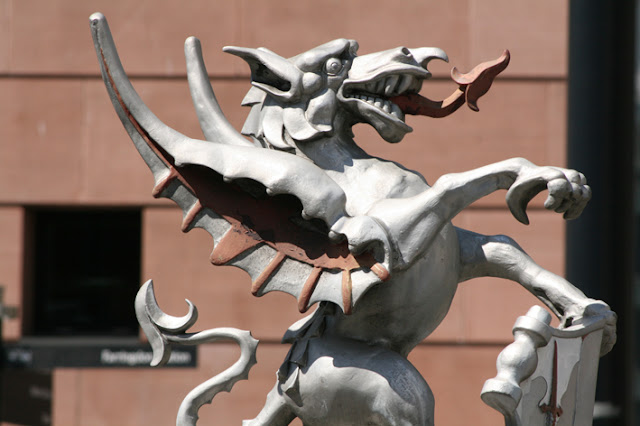
THE FARRINGDON ROAD DRAGON
DRAGONS
A dragon is a winged reptile, a scaled creature, with the tail of a serpent, capable of breathing smoke or fire. Think teeth, flared nostrils, scales and a snake-like tail and you’ve got the essence of a dragon! These creatures can be found throughout history even back to bible times, where the devil is referred to as being a dragon, in the book of Revelation. In classical legend, they are associated with guarding something. For example, in Greek mythology, a ten headed dragon guarded the golden apples, in the Garden of the Hesperides. In medieval romance, dragons spent a lot of time guarding pretty, captive women. In England, we associate St George with slaying the Dragon and indeed dragons guard the City of London and mark out the different gates around the city i.e Aldersgate, Bishopegate, Temple Bar, Bridge Gate and Moorgate.


THE VICTORIA EMBANKMENT DRAGON

THE CITY OF LONDON 
The City of London boundary or ‘square mile’, the original heart of London, established by the Romans, in 55BC, is surrounded by dragons, which are the most obvious and visible dragons, in the City of London, but if you’re interested and can spare the time, you could go on your on a dragon hunt, which will take you all over the City!

DRAGONS ON HOLBORN VIADUCT BRIDGE, BUT THESE ARE NOT BOUNDARY DRAGONS
However, for my boundary project, I am just concentrating on the boundary dragons. These fierce and very angry looking silver beasts, stand on plinths, at various points around the boundary of the City. They are all clutching shields, which bear the red cross of St George and the short sword of Saint Paul. The dragons found on Victoria Embankment, are the biggest and also the original dragons from which all the others are based. These two dragons are made of cast iron and stand on plinths of Portland Stone. Originally these dragons had their home at the entrance of the Coal Exchange in Lower Thames Street. 

THE COAL EXCHANGE, LOWER THAMES STREET. IF YOU LOOK CLOSELY YOU CAN SEE
THE TWO DRAGONS THAT NOW HAVE A HOME ON VICTORIA EMBANKMENT
The coal exchange was designed by City Architect, J.B. Bunning between 1847 and 1849. The minutes of the Coal, Corn and Finance Committee for 2nd July 1847 record that Bunning had furnished the founder, Dewer with drawings for the several castings required, received estimates for them including two cast iron griffins or dragons with shields, both from one pattern, including modelling, carving, delivery and fixing, complete for £70 each. In 1963 the Coal Exchange building was pulled down and the dragons relocated to their present position and inaugurated on the 16 October 1963. The following year The London Streets’ Committee recommended that the boundary dragons mark all the main entrances to the City. The Chairman decided that the Coal Exchange dragons should serve as templates for all the dragons, rather than the one designed by C.B. Birch at the Temple Bar Memorial. On the 9th of March 1965 approval was given for half size dragons to be erected at approved sites at the cost of £2,998.

THE TEMPLE BAR DRAGON IN FLEET STREET, WHERE THE CITY MEETS THE WEST END

TEMPLE BAR DRAGON 
The Temple Bar dragon is the tallest of all the dragons and has a very gothic look to it. Unlike the other boundary dragon, it is black and not silver. It stands over the Temple Bar Memorial on Fleet Street by the Royal Courts of Justice. It is at this point that the City of London meets the City of Westminster. The Temple Bar was the most celebrated gateway to the City. It used to be at this point, where the ruling monarch would be met and welcomed into the City by the Lord Mayor. The original 17th century Temple Bar gateway, has now been restored and installed between St Paul’s Cathedral and Paternoster Square.


BLACKFRIARS BRIDGE AND HIGH HOLBORN DRAGONS
LONDON BRIDGE DRAGON AND A DRAGONS BACK
THE BISHOPGATE DRAGON, A FEW YARDS FROM THE LIBERTY OF NORTON FOLGATE
SHADOW OF THE DRAGON, ENTER IF YOU DARE!

Tuesday, 20 September 2011

DEVELOPMENT OF ROMAN ALPHABET & 3D TYPE BOOK

Over the last while I have been working on these two hand made books. The first is the development of the roman alphabet, which is finished. The second is a 3D come anatomy of type book (not yet finished). I wanted to make the letters pop up as each page opens. My pop up letters are quite basic put it does the job.


Tuesday, 13 September 2011

WOOD CARVING - STEPHANIE

I have been neglecting my wood carving of late, too many other college projects to do. But I have just finished these two pieces. This time I have used Iroko wood. Iroko is a large hardwood tree from west coast of Africa. It is one of the woods sometimes referred to as African Teak. It is used mainly for boat-building, domestic flooring and furniture. I did not find it ideal for carving letters, it seemed to work better with the bigger carved letters rather then the small. But it polished very nicely giving a very smooth finish.


The first piece LOVE, was just me messing about with some free hand drawn letters, I was happy with the L and O but not so happy with the V and E.


The second piece STEPHANIE, was a personal work. Stephanie for those who don't know was one of my children who died some years ago aged 2. My wife and I published a small children's book about her life called Happy Days. When you lose someone people often say " Oh I am sorry for your loss". But we never lost Stephanie we know exactly where she is. 


Anyway back to carving the wood, I found cutting these smaller letter forms very difficult you need very small chisels. It really helps to choose a celtic letter form, it covers a multitude of bad carving. As for the angel I carved,  well its more of an engraving really, I did this using whats know as a V chisel.


P.S. If you would like to read Happy Days go to:


Happy Days The Story of Stephanie Whitton

Monday, 12 September 2011

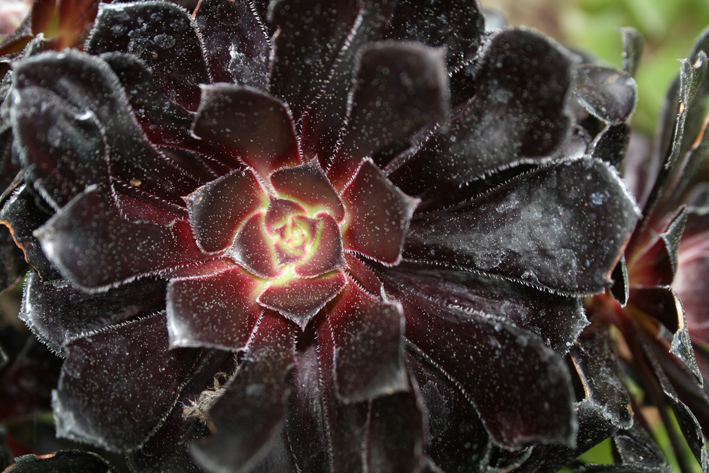
UP CLOSE WITH CACTI

I visited Lullingstone Castle in Eynesford, Kent at the weekend. The world garden in the Castle has a Cacti green house. These Cacti are amazing plants, perfect examples of colour and design. I stuck my camera as close to the plants as possible and got these results. Enjoy!


Tuesday, 6 September 2011

BOB DYLAN - PAPER CUT

I have been experimenting with paper cutting after starting a course at the Dulwich Picture Gallery. This is a work I have just completed.  

Firstly I found a picture of Mr Dylan on the Internet, I then took it into Photoshop and turned it into a rubber stamp with one of the filters. From here I placed the bitmap image in Illustrator and put the wording in. This I scaled to A2 and traced the image onto thin black paper 100gsm, (the thinner the better for easier cutting). The head and lettering within the head I cut out to leave one single silhouette. It is very fiddly and you need a very sharp scalpel 10A blade works best. The cut out letters I stuck down to add to the overall effect. I used a Japanese hand made paper as a backing sheet.


A2 FRAMED PAPER CUT
ILLUSTRATOR FILE